|
October 30, 2009 – I have most of my $1.7 million of investable assets in the US and have become concerned that the federal government will impose exchange controls because of the growing inflation risk. Can you please let me know how you would invest this money to avoid the risks of inflation and exchange controls?
James Turk replies: I think your concerns are well founded, and you are not alone. Just this past Tuesday a top advisor to French President Nicolas Sarkozy told reporters that the US was “flooding the world with liquidity”. He went on to say: “Historically, we have only ever got out of such situations with inflation…[and]…if we lose control of inflation and there is hyperinflation, it’s a catastrophe for everyone.”
Exchange controls are also a real risk. In fact, the federal government has already imposed controls on the free-flow of capital. For example, there are various reporting requirements on how much cash one can move across borders. More importantly, the federal government has imposed so-called “qualified intermediary” requirements on non-US firms wanting access to US financial markets. Bloomberg reports that the oldest private bank in Switzerland is telling its clients to sell U.S. assets or leave. The report by Wegelin Bank explaining their decision is also worth reading.
Given the deteriorating financial problems of the federal government and the policies being pursued by the Federal Reserve, it seems likely that inflation will worsen. It is therefore inevitable in my view that the federal government will impose draconian capital controls in an attempt to keep its fiat currency game going, rather than return to sound money as required by Article I, Sections 8 & 10 of the Constitution.
To avoid the risks of inflation and government controls, I have some basic thoughts, which focus more on strategy than specific asset allocation. Also, these thoughts are of a general nature and therefore may not be for everyone.
1) The driving force in my thinking has been that I believe the US dollar (and probably the other major world currencies as well) are headed for hyperinflation. I am talking months - and not years - in the future. The US stock market is not rising because of improving economic conditions. It is rising because too much money is being created, and it inevitably ends up in stocks. A rising stock market in the face of deteriorating economic conditions (as evidenced, for example, by rising unemployment) is an early warning signal of hyperinflation. Thus, investment should be directed toward tangible and near-tangible assets as I explain below. Avoid financial assets, i.e., those denominated in currency like bank accounts, annuities, bonds, etc.
2) You should diversify your assets and get as much of your wealth as practical outside of the United States. When you are concerned about government controls, do not hold investment assets in the country where you live or where you are a citizen. It is becoming increasingly difficult for Americans to open bank and brokerage accounts in Switzerland and most financial centers, which makes it all the more important as a means of prudent diversification of one’s assets to open these accounts while you still can.
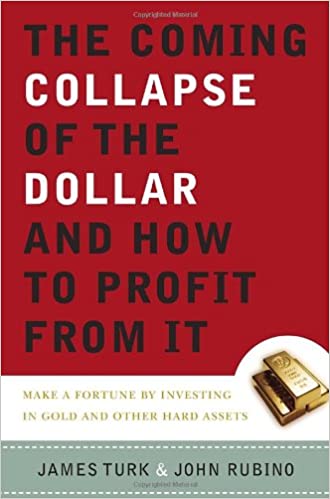
3) As noted above, I expect government controls to be imposed. Though the nature of the controls cannot be predicted, they will without doubt restrict your freedom to do what you want with your money. For this reason, think carefully about how much of your wealth is exposed to government controls and/or confiscation through IRAs, 401Ks and other deferred tax plans, as I explain in The Collapse of the Dollar. I think the risk of government confiscation is real, where the government seizes assets in deferred tax plans which it replaces with illiquid government paper (like a zero coupon 100-year maturity ‘national financial emergency’ bond).
4) I would avoid owning assets denominated in currencies. For example, bank deposits do not pay enough interest income to offset the risks. I would particularly avoid the US dollar and British pound. They are in the worst shape, but the euro is not far behind. The Swiss franc is not a viable alternative either because in a financial crisis, non-Swiss will be penalized like they were in the late 1970s with negative interest rates or some other scheme the Swiss justifiably impose to prevent hot-money from flowing into Switzerland. Also, the people who run the Swiss National Bank today are not of the same caliber of those who ran it in the 1960s and 70s, so I really wonder whether the Swiss franc will weather the storm this time around.
5) Because of the currency risk and also a real and growing default risk, avoid government bonds and bills. Because of the currency risk, I do not like corporate bonds, unless they are investment-grade rated and convertible into equities.
6) My view is that for now and the foreseeable future, liquidity should be kept in physical gold, not currencies, which in fact, has been my view this decade. Many people use the company I founded, GoldMoney to achieve this objective. The table on this page illustrates gold’s annual average double-digit rate of appreciation this decade against nine of the world’s major currencies. Gold has been far better than any currency in preserving purchasing power, and when you hold physical metal, you don't have counterparty risk - which is increasingly important these days because of insolvent banks worldwide. If you need a national currency for an expense or to make an investment, then sell gold as required. Do not own paper-gold though, and do not store the gold you own in the States because of its past history of confiscation there, though you may want a little gold or silver to keep on hand around the house just in case.
7) One should favor tangible assets that make sound economic sense (farmland, timberland, apartment buildings with inflation escalator clauses in the leases, etc) and near-tangible assets (equities of well-managed companies that produce goods and services people will want to purchase regardless what happens to the currency). Avoid financial assets of the nature explained above.
8) For investment income, look to well-managed companies that pay dividends. For example, Canadian oil-sands royalty trusts as I have been recommending are one good way to accomplish this objective. So are defensive stocks as well as the few mining companies that pay dividends.
10) Diversify the stocks you own to make sure that no more than 20% is invested in companies located in any one country.
That sums up several key areas to think about, but there is one last point, as further food for thought. Please see my article “Do You Have a Last Plane Account”.
September 1, 2009 - You often mention backwardation. What is it, and why is it important?
James Turk replies: Backwardation occurs when a future price of gold is less than the spot price. To explain why it’s important, you have to look at dynamics of the spot price of gold, which is the interaction of all gold trading, paper and physical.
There are professional traders who do nothing but arbitrage these two markets – paper gold and physical gold. For example, if the price on the Comex is out of line with the physical market, a bullion bank may sell the overpriced market and buy the underpriced one to earn the spread. It's a lot more complicated than that because of the various costs involved, but that is the basic principle.
Here’s the significance of backwardation. The current spot price is an accurate record of the real spot price of physical gold as long as people are willing to exchange currency for gold at that price, which is why backwardation is so important. If gold goes into backwardation - which is rare, but it happens - then the physical price is diverging from the paper price. No one is willing to arbitrage. The reason is that they are worried about two possible events.
One is default, i.e., someone won't make good on their paper promise to deliver. The other is debasement, i.e., the government takes some action to make the currency less valuable relative to gold. So rather than selling their physical metal today and holding currency until someone delivers gold back to them in the future at a lower price - enabling them make a profit from the arbitrage - the holders of physical metal choose not to sell. They are willing to give up a profit to keep their bullion safe, rather than exchange it for a national currency and the risks of default or debasement.
It can be difficult to determine during the trading day whether gold is in backwardation. Various intraday prices posted on the Comex do not necessarily reflect the spreads (the difference between spot and the future price of different futures contracts), and the spreads are essential to know whether or not there is backwardation. Single contracts can trade at disparate prices during the day and be out of whack with each other relative to the spreads. Only settlement prices at the end of the day captures the accurate spreads.
Settlement prices are important for margin purposes, so the exchange is careful to make sure they are accurate. Therefore, if during the day you want to determine whether there is backwardation, you need to ask a floorbroker for the spread between the months you are interested.
August 25, 2009 - With 60%-70% of US dollars held offshore, isn't there a strong potential for the US dollar to collapse as foreigners try to repatriate dollars back to the US?
James Turk replies: Yes, but you seem to assume that the US government will allow all those dollars now overseas to be sent back to and spent in the States. It may instead choose to impose some capital control. The control would prevent those dollars overseas from returning home because if they did and were spent on goods and services, there no doubt would be massive hyperinflation.
Remember though, there are two types of dollar currency - the paper notes we carry in our pockets and the dollars deposited in our bank account. It may be that 60-70% of dollar paper currency is held offshore, but not that high a percentage of M3, which is a measure of both types of dollar currency.
Deposit currency is relatively easy to control - the feds just instruct US banks to stop overseas dollars from being wired to domestic accounts, or to deduct a newly imposed capital control tax of, say, 50%, before the overseas dollars are credited to a domestic account. Paper currency could be controlled by printing new pink notes for domestic circulation, and the old green notes could only be converted into pink notes by US citizens (with, for example, IRS approval that the US citizen's tax status is in order). Similar types of actions have been pursued time and again in various countries, with the same result. In the end, they all straws on the camel’s back that eventually destroy the currency.
August 18, 2009 - Why is there never any discussion surrounding the subject of the issuance of paper gold? Banks in Canada sell Gold Certificates as well as Silver Certificates. These pieces of paper are lapped up by unsuspecting customers as if they were real gold. If this paper gold is considered by 90% of the purchasing public as true gold, then there is essentially an UNLIMITED supply of 'gold' for sale. If gold can be mined by a laser printer in every single bank in the world, how exactly is the spot price of gold relevant in any discussion? Banks are creating gold in the same fashion that they create money...out of thin air.
James Turk replies: You raise some good points, and I am in agreement with you. For a long time I have been trying to inform people about the difference between physical gold and paper gold. Here is one example.
http://goldmoney.com/essays-own-metal.html
Here is another example of some correspondence about gold certificates published by GATA a few years ago.
http://groups.yahoo.com/group/gata/message/1527
http://groups.yahoo.com/group/gata/message/1535
http://groups.yahoo.com/group/gata/message/1559
http://groups.yahoo.com/group/gata/message/1562
When you own paper gold, you do not own gold. You own exposure to the gold price, which is contingent upon counterparty risk of the entity promising to deliver gold to you in the future. Physical gold - being a tangible asset - does not have counterparty risk.
Slowly but surely the market is beginning to understand this difference. The tipping point may have been reached last month when it was reported that Greenlight Capital Inc., a prominent hedge fund, had converted its holdings of GLD into physical metal.
http://www.bloombergnews.com/apps/news?pid=20601213&sid=arz6MqVbTVBs
This switch into physical may cause other firms to follow Greenlight’s lead.
The point is that there is a lot more paper out there than physical metal. It's like the children's game of musical chairs. There are not enough chairs. The promises to deliver physical metal dwarf actual metal available for delivery, but they key is - when will the music stop? When it does, there will be a scramble for physical metal.
As the economy continues to contract, unemployment grows and banks take more losses on their loan portfolios, confidence will erode further causing more doubts about paper promises, which in turn will cause people to convert their paper gold into physical gold. Eventually the demand for physical metal will become overwhelming, just like it has been at many other periods throughout monetary history. Many people who hold paper gold will then learn an unfortunate but valuable lesson - sometimes the promises aren't worth the paper they are printed on.
Consequently, there are limits to how much paper gold can be printed. If we reached the tipping point last month as I suspect is possible, then the contraction of outstanding paper gold obligations will send the gold price soaring as those who have promised gold, but don't have it on hand, go into the market to buy metal to meet their promise to deliver and avoid a default. This rush out of paper gold into physical metal will accelerate when gold climbs above $1,000. I expect gold will hurdle this level this year.
August 12, 2009 - Are UK investors are taking an unnecessary bet on the US dollar/Sterling exchange rate by investing in gold through a vehicle such as an ETF or ETC which does not provide a currency hedge? What is your view on this? Are there other ways in which UK investors buying into gold can mitigate the currency risk?
James Turk replies: The basic premise that UK investors are taking a USD/GBP exchange rate risk by buying gold captures exactly the muddled thinking about money so prevalent today.
What investors need to hedge against is the loss of purchasing power, which can arise the following ways:
1) Inflation - For decades central banks have been expanding the supply of money at a rate greater than the demand for money with the inevitable result that prices of goods and services rise, meaning the currency loses purchasing power. I recently wrote the following article on this point.
http://www.kitco.com/ind/Turk/turk_jul272009.html
2) Exchange rate fluctuations - Purchasing power is lost in this case when the exchange rate of one currency falls against another currency. A good example is the huge drop in the British pound against the euro over the past couple of years.
3) Counterparty risk - In this case, the entire purchasing power of the currency you hold is lost if the counterparty where you have deposited that money goes bankrupt. We almost saw this event happen with Northern Rock, but it was a regular feature during the Great Depression.
There is basically only one way to hedge against all of the above risks. It is to buy gold.
I refer to the following chart which clearly illustrates that gold is money.

The above chart presents a base-100 analysis of crude oil prices in terms of four different currencies and goldgrams, i.e., grams of gold. In other words, to establish the useful comparison depicted above, the analysis presented in this chart assumes that one barrel of crude oil equals 100 in each of these currencies as of January 1950. It thereafter calculates the month-end price based on the actual dollar price of crude oil and the prevailing dollar-to-currency rate of exchange.
Throughout this 60-year period the goldgram price of crude oil has remained essentially unchanged. The price of crude oil in these national currencies only remained unchanged when they were linked under a fixed rate regime to the dollar, which itself was defined as a weight of gold. When the currency fixed-rate regime and the dollar’s link to gold were ended in August 1971, the discipline previously imposed on the supply of dollars and other currencies also ended, and the inflationary increases in the price of crude oil and other goods and services since then has been the result.
Had the gold standard not been abandoned in 1971, nobody today would be talking about the rising price of crude oil simply because the price of crude oil would not be rising.
This chart makes clear that gold preserves purchasing power over long periods of time. My insight is not new.
The world is today re-learning what Britain learned from the Bullion Committee formed by Parliament during the Napoleonic Wars. The following quote makes this point. It is from Henry Thornton, An Enquiry Into the Nature and Effects of the Paper Credit of Great Britain (1802).
“We naturally imagine that the spot on which we ourselves stand is fixed, and that the things around us move. The man who is in a boat seems to see the shore departing from him, and it was the doctrine of the first philosophers that the sun moved round the earth, and not the earth round the sun. In consequence of a similar prejudice, we assume that the currency which is in all our hands, and with which we ourselves are, as it were, identified, is fixed, and that the price of bullion moves; whereas in truth, it is the currency of each nation that moves, and it is bullion, the larger article serving for the commerce of the world, which is the more fixed.”
The book is online at the following link.
http://oll.libertyfund.org/index.php?option=com_staticxt&staticfile=show.php%3Ftitle=2041&layout=html
Gold and the pound were one and the same when they were linked by the British sovereign coin (pound notes were redeemable into gold sovereigns). Today the pound and gold are obviously different, so there is only one way to get a true picture of what is happening to a currency's purchasing power. The price of goods and services has to be measured in terms of both the currency and gold, as I have done in the above chart.
Therefore, UK investors should properly be focusing on hedging the loss of purchasing power. The best way to do that is to buy gold, and I mean physical gold - only physical gold eliminates counterparty risk (#3 above). Paper gold products like certificates, ETFs, ETCs, etc. have counterparty risk. With paper gold you only own exposure to the gold price - you do not own gold. And that exposure to the gold price is contingent upon someone making good on their promise, which is the counterparty risk.
Lastly, there are only two ways to buy physical gold. You buy it and store yourself or you buy it and have someone store it for you, which is what we do in the company I founded, GoldMoney. We're now storing over US$670 million worth of precious metals owned by our customers.
|